

A set of socket adapters taught me something about supply chains last week. The lesson is not about ships or warehouses. It is about how much time we lose between the steps of our work.
On October 31, I bought a set of Icon socket adapters at Harbor Freight as an ordinary paying customer. Icon is one of the company’s professional tool lines. The package says the adapters were manufactured in Taiwan. A small white sticker on the back shows the code 092026, which I read as a packaging date of September 20, 2026.
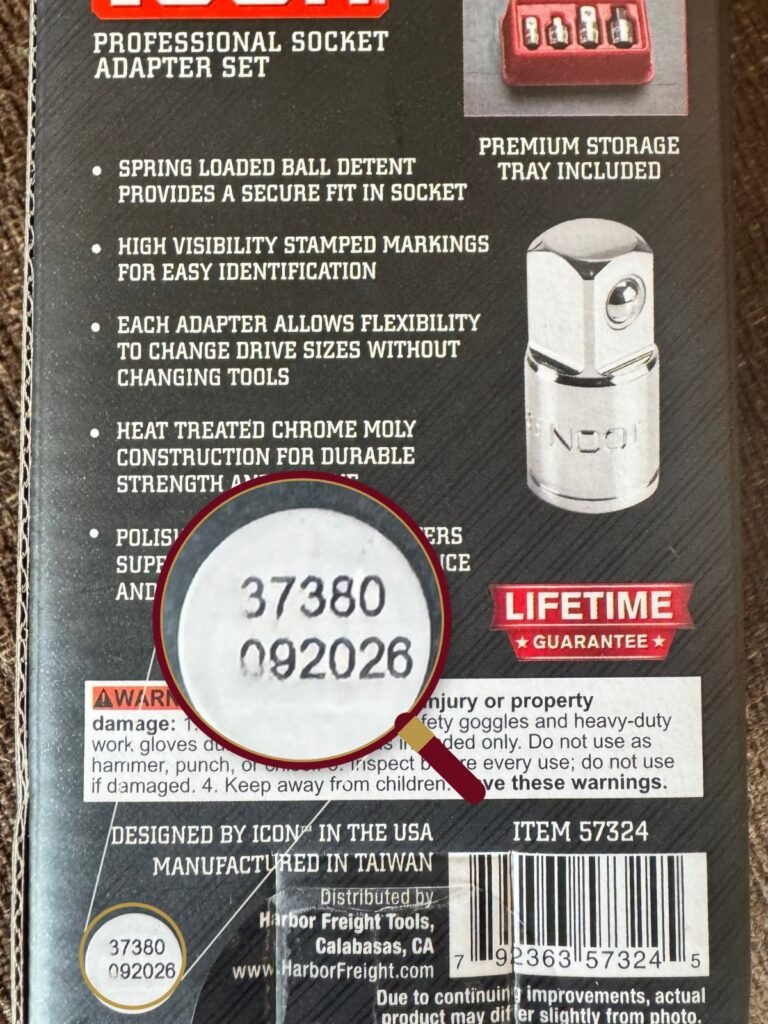
The code could also mean September 2026 in general, with no specific day. Read that way, the adapters went from packaging to my purchase in somewhere between 31 and 60 days. That is still fast. Freight companies say ocean shipments door to door often take 25 to 55 days or more, and that range only covers getting the goods to their destination. It does not include stocking a store shelf, running a sale, and making a sale.
That is 41 days. In about six weeks, those adapters were packaged, trucked to a port, loaded onto a ship, carried across the Pacific Ocean, cleared through U.S. customs, moved to a distribution center, shipped to a store, placed on a shelf, advertised as a sale item, and sold to me.
I have spent my career improving processes, and I know how hard it is to move a simple request through one department in 41 days. So I wanted to understand how Harbor Freight does it, using only what any customer can find in public sources.
Why 41 Days Is Fast
The ocean crossing alone takes a large share of that time. Freight companies list these typical times for shipping from Taiwan to the United States:
| Route | Typical time |
|---|---|
| Taiwan to the U.S. West Coast, port to port | About 14 to 25 days |
| Taiwan to the U.S. East Coast, port to port | About 28 to 45 days |
| Door to door by ocean, including ports and trucking | Often 25 to 55 days or more |
| My socket adapters, packaging to store sale | 41 days |
The ship is only one part of the trip. Before it sails, the product has to be packed and moved to the port. After it lands, the container has to be unloaded, cleared through customs, and moved inland. Then the product has to be sorted, sent to a store, and put on a shelf. Finally, it has to be promoted. My adapters were already being advertised on sale, which means the marketing plan was ready when the product arrived.
Every one of those steps is a handoff from one person, company, or system to the next. And every handoff is a chance for the product to sit and wait. Harbor Freight got all of that done, plus an advertised sale and a purchase, inside a window that many importers need just to reach their own warehouse.
How Harbor Freight Does It
Harbor Freight is a private company and does not publish its shipping times. But public records show a system designed to remove waiting at every step.
1. It buys directly from the factory. Since its early days, Harbor Freight has bought tools straight from manufacturers instead of going through middlemen. The company presents this as a way to lower prices, and it also removes a layer of handoffs. (Harbor Freight)
2. It ships straight to its own buildings. U.S. customs records show a 2024 shipment of more than 1,300 cartons sent from the port of Taipei, Taiwan, directly to Harbor Freight’s distribution site in Dillon, South Carolina. (Panjiva)
3. It helped bring the port inland. In 2018, South Carolina opened Inland Port Dillon, a rail terminal that connects to the Port of Charleston. Harbor Freight was its first customer. Containers ride an overnight CSX train from Charleston to Dillon instead of making a long truck trip, and Harbor Freight’s distribution center is only minutes away. (Charleston Business; SC Biz News)
4. It puts warehouses close to the ports and the stores. Harbor Freight runs distribution centers in California, South Carolina, Illinois, and Washington. Its Washington facility sits near the Seattle and Tacoma ports and earned it the Northwest Seaport Alliance’s 2023 Importer of the Year award. (SupplyChain247)
5. It keeps cutting the miles. When Harbor Freight opened its Joliet, Illinois, center in 2022, it noted that its 300 Midwest stores had been supplied from distant centers in California and South Carolina. The new building uses automated storage and robotic equipment. (Harbor Freight Newsroom)
None of these steps makes the ship sail faster. They make everything around the ship faster.
The Lesson for Leaders: Speed Lives Between the Steps
When a process is slow, our first instinct is to ask people to work faster. Harbor Freight’s approach points somewhere else. Most delay does not happen while work is being done. It happens while work is waiting: in an inbox, in a queue, on a loading dock, or for someone’s approval.
I see this in nearly every process I study. A task that takes 20 minutes of actual work can take two weeks to finish because it passes through five people, and each one holds it for a few days. The work is fast. The handoffs are slow.
Harbor Freight attacked the handoffs. It removed middlemen, built a direct rail link, and moved its warehouses closer to where products arrive and where customers shop. Each change removed a place where products would otherwise sit.
You can apply the same thinking to any process, whether it is customer service, hiring, purchasing, or onboarding:
- Map every step. Write down each step from start to finish, including who touches the work and what they do.
- Count the handoffs. Every time work moves from one person, team, or system to another, mark it. Each mark is a place where work can wait.
- Measure waiting, not just working. For each step, compare the time spent doing the work with the time the work spends sitting. The gap is usually surprising.
- Remove or shorten the biggest waits. Cut steps that add no value, combine handoffs, or move decisions closer to the people doing the work.
- Put resources where the work flows. Harbor Freight built warehouses near ports. In an office, that might mean giving frontline staff the authority to solve common problems without waiting for approval.
The Bottom Line
A set of socket adapters crossed an ocean and reached my hands in 41 days. That speed did not come from one heroic effort. It came from a system designed so that products spend as little time as possible waiting between steps.
If a tool can travel from Taiwan to a store shelf in about six weeks, it is worth asking how long a simple request takes to move through your own organization, and where it sits along the way.
What is the slowest handoff in your organization? Join the community conversation, and subscribe to the newsletter for new articles on leadership and operations.
Disclosure: This article reflects my own observations and opinions as a Harbor Freight customer. It was not authored, authorized, sponsored, or reviewed by Harbor Freight Tools, and I received no payment, products, or other compensation for it. The description of Harbor Freight’s operations is based only on publicly available sources, listed below. Harbor Freight Tools and Icon are trademarks of their owner.
Sources
- Flexport. Kaohsiung, Taiwan to Los Angeles ocean freight rates and transit times.
- iContainers. Importing from Taiwan.
- Harbor Freight Tools. Where Does Harbor Freight Get Their Tools?
- Panjiva. Harbor Freight Tools U.S. import shipment records.
- Charleston Business (2018). Port opens rail-served inland terminal in Dillon County.
- SC Biz News (2018). Inland Port Dillon opens.
- SupplyChain247 (2023). NWSA Honors Supply Chain Leaders with 2023 North Star Awards.
- Harbor Freight Newsroom (2022). Harbor Freight Tools Opens New Distribution Center in Joliet.
Leave a Reply
You must be logged in to post a comment.